
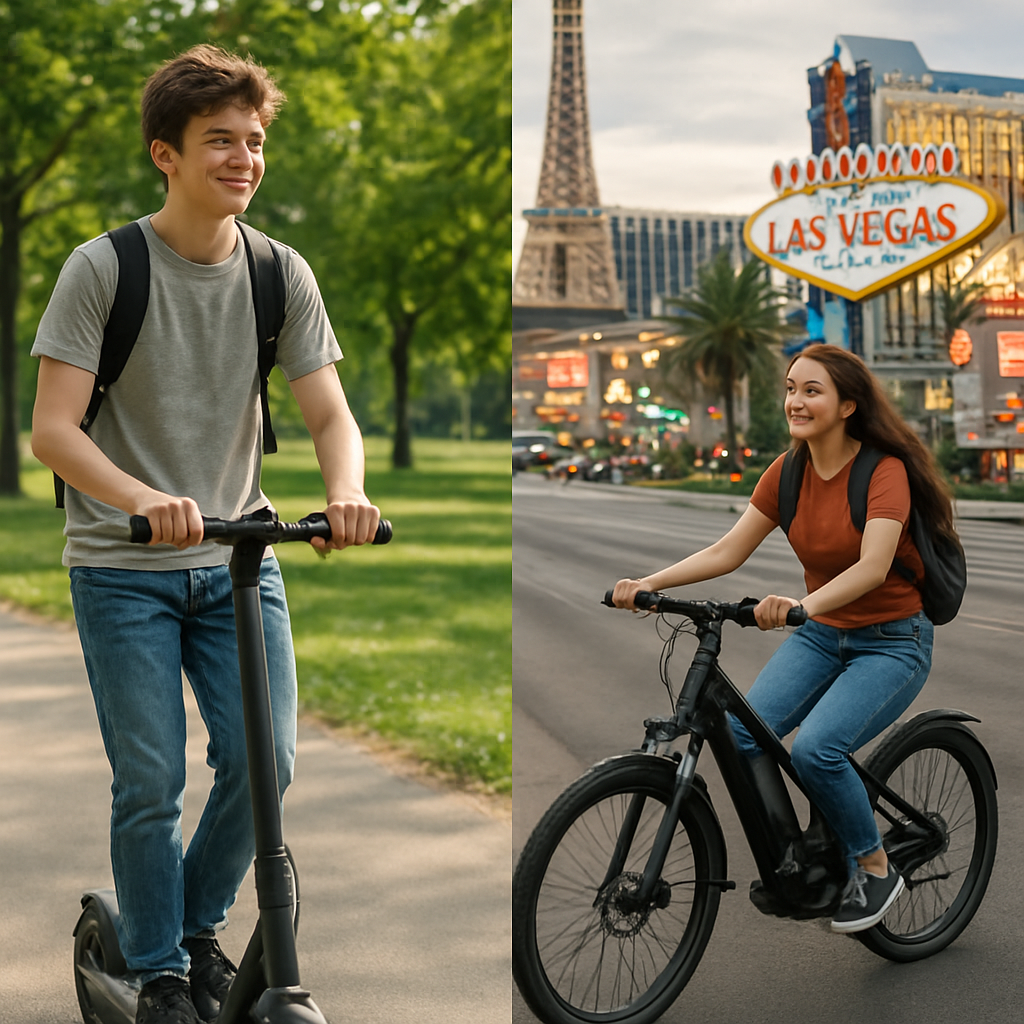
Nevada's streets have transformed dramatically with the rise of electric bikes and e-scooters, offering residents convenient, eco-friendly alternatives to traditional transportation. But before you hit the road, you need to understand the rules — because the consequences of getting them wrong can range from costly tickets to serious liability exposure in the event of an accident.
This guide breaks down what state law requires, how local ordinances differ, and what you need to know to ride smart and stay safe.
The Electric Revolution Meets Nevada Regulations
Nevada recognizes three classes of e-bikes based on motor power and speed:
- Class 1 — Pedal-assist only; motor stops assisting at 20 mph
- Class 2 — Throttle-powered; motor stops at 20 mph
- Class 3 — Pedal-assist only; motor stops assisting at 28 mph
Class 1 and Class 2 e-bikes face fewer restrictions than Class 3 models, which deliver higher speeds and therefore carry additional compliance requirements. Meanwhile, e-scooters occupy a distinct regulatory category that differs significantly from e-bike rules.
Identifying your vehicle type is the first step. The rules that apply to you depend entirely on what you're riding.
The governing Nevada statutes for these vehicles are found in NRS Chapter 484B — Rules of the Road, specifically:
- NRS 484B.017 — Definition of "Electric Bicycle" and its three classes
- NRS 484B.018 — Definition of "Electric Scooter" and applicable requirements
These statutes establish the baseline rules for operation throughout Nevada, and local ordinances build upon them.
Safety Equipment: What You Must Carry and Wear
Nevada law mandates specific safety equipment to reduce injury risks and limit liability if an accident occurs.
Lighting requirements: All e-bikes and e-scooters operated during darkness or reduced visibility must display functioning front and rear lights. Reflectors must also be positioned on pedals, wheels, and the rear of the device to enhance your visibility to other road users.
Helmet requirements: State law requires all riders under 18 years old to wear an approved safety helmet whenever operating an e-bike or e-scooter on public roads. Many Nevada cities have gone further, extending helmet mandates to adult riders as well — so always check your local rules.
This matters beyond just avoiding a ticket. In a personal injury claim, riding without a required helmet can be used to argue that you contributed to your own injuries — reducing or even eliminating your recovery. Compliance protects both your body and your legal rights.
Beyond helmets, riders should consider:
- Wearing reflective clothing, especially at night
- Using a bell or horn to alert pedestrians
- Keeping both hands on the handlebars in traffic
Age Restrictions, Local Ordinances, and Where You Can Ride
State minimums: Nevada law generally permits riders as young as 14 to operate Class 1 and Class 2 e-bikes independently. Younger children may ride e-bikes only with adult supervision. E-scooter age requirements are typically more restrictive and vary by municipality.
Clark County: Clark County adopted a significant e-bike and e-scooter ordinance that took effect in 2025. Key provisions include:
- E-bikes and e-scooters are prohibited from operating on public sidewalks and public pedestrian easements in the resort corridor
- Vehicles must weigh less than 100 lbs
- Speed is limited to 15 mph in County parks
- Class 2 and Class 3 e-bikes are banned in County parks
- Stunts, wheelies, and similar maneuvers are prohibited
- Fines start at $150 for a first violation, up to $600 for repeat violations
You can review the full Clark County Code of Ordinances — including the e-bike and e-scooter provisions — at the Clark County Municode Library.
Las Vegas and Henderson have implemented comprehensive e-scooter sharing regulations covering parking, speed limits, and geofencing for shared-fleet operators. These requirements apply in addition to state law.
The patchwork problem: What's permitted in one Nevada city may violate ordinances in the next. Before riding between communities, always verify the local rules at your destination. A violation in Henderson may reflect different rules than the same behavior in Las Vegas.
Liability: Why Compliance Is About More Than Avoiding Tickets
Riding in compliance with Nevada's e-bike and e-scooter laws isn't only about dodging fines — it directly affects your legal position if you're ever in an accident.
Nevada follows modified comparative negligence rules. If you were riding without a required helmet, operating in a prohibited zone, or exceeding a local speed limit, an insurance company or opposing attorney will use that non-compliance to argue that you were partially at fault for your injuries. Under Nevada law, if you're found more than 50% at fault, you recover nothing.
Staying compliant keeps both you and your legal rights protected.
Official Resources
Nevada Revised Statutes:
Clark County:
Las Vegas:
Henderson:
Reno:
The information provided in this post is for general informational purposes only and does not constitute legal advice. Laws change frequently, and local ordinances vary. Always consult an attorney or your local municipality for guidance specific to your situation.
If you were injured in an e-bike or e-scooter accident, don't wait to get legal guidance. Call the personal injury lawyers at Cap & Kudler for a free consultation with an attorney — (702) 878-8778.
Injured in an Accident? We Can Help.
Call Cap & Kudler for a free consultation. Our attorneys personally handle every case and fight to get you the compensation you deserve.
(702) 878-8778