
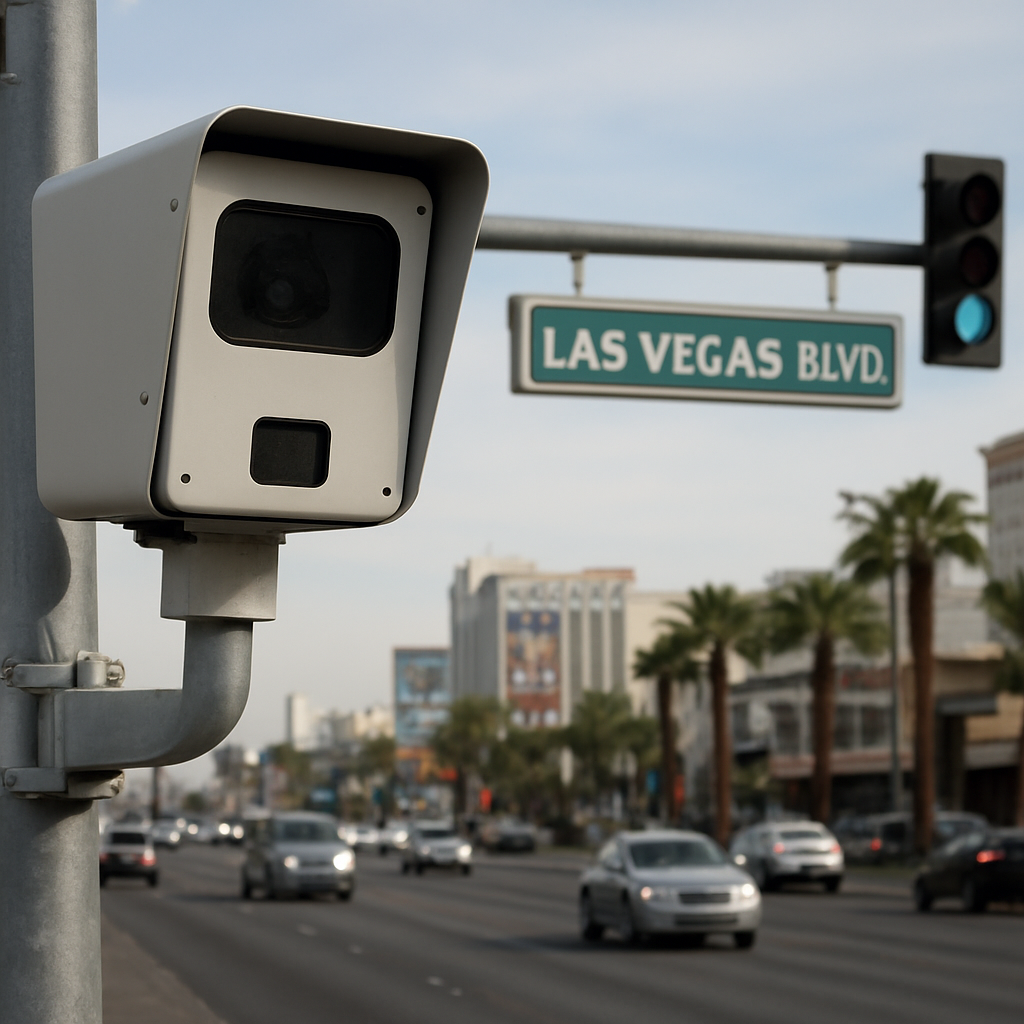
If you've been in a car accident in Nevada, you might wonder whether traffic cameras captured what happened — and whether that footage can help prove your case. The answer is more nuanced than most people realize, and it could make a real difference in your claim.
Here's what you need to know.
The Important Legal Distinction
You may have heard that Nevada law restricts traffic camera use. That's true — but only in a specific, limited way.
Nevada law (NRS 484A.600) prohibits using traffic camera footage to issue traffic tickets. That ban applies to enforcement — to the government mailing you a citation based on a camera photo. It does not apply to civil personal injury lawsuits.
In a civil case, the rules are different. Any relevant, admissible evidence can be used — including video footage that shows exactly how your accident happened. So while the state cannot use a camera photo to send you a ticket, an attorney absolutely can use video footage to argue who was at fault in a lawsuit.
That distinction matters a great deal.
The Core Challenge: Government Traffic Cameras Don't Record
Here's where things get complicated.
The Nevada Department of Transportation (NDOT) confirms on its public records page that its traffic cameras are designed for real-time monitoring only — they are "not set to record." That means if you submit a public records request to NDOT hoping for saved footage from the day of your accident, you will almost certainly come up empty. The footage was never stored to begin with.
So even though you legally could use that footage in court, NDOT's cameras generally aren't capturing anything you can retrieve after the fact.
Third-Party Companies Have Filled the Gap
This is where things get more interesting. Several private companies recognized the gap left by NDOT and stepped in to record those public livestreams themselves.
Nevada Traffic Cam Archive (nevada.trafficcamarchive.com) — A private company that continuously records Nevada's public traffic camera livestreams and archives footage for Las Vegas, Reno, and Carson City. They claim more than 2.24 million hours of archived footage. Their goal is to retain footage for at least 90 days (sometimes 120–150 days). Anyone — including attorneys, insurance companies, and individuals — can browse their interactive map, preview footage, and purchase and download video. They market directly to law offices for fault disputes.
RoadProof (roadproof.com) — A nationwide platform with millions of hours of recorded traffic camera footage from thousands of cameras across the country, including Nevada. Used by law enforcement agencies including LVMPD and available to attorneys and private individuals.
National Traffic Video — A Las Vegas-based company that records Nevada traffic cameras and has been featured in local news coverage for capturing unusual incidents, including crashes.
These services exist and are actively marketed to legal professionals handling accident claims.
A Word of Caution About Third-Party Footage
Not all footage is created equal.
At least one Nevada personal injury law firm has publicly noted that footage from third-party services that record public livestreams "might be altered or otherwise compromised." The concern is about chain of custody — can you verify that the footage is authentic and hasn't been tampered with before it reached you?
This doesn't mean the footage is worthless. It means that if you or your attorney plan to rely on it, the source and integrity of that footage need to be carefully evaluated before it becomes a cornerstone of your case.
Other Cameras That Do Record — and Can Be Used
Even when government traffic cameras don't capture usable footage, other sources often do. Nevada — and Las Vegas in particular — is one of the most camera-covered places in the country.
Sources that may have recorded your accident:
- Private business security cameras — Casinos, hotels, retail stores, restaurants, and gas stations all maintain extensive camera systems. If your accident happened near any of these, there's a real chance the incident was captured.
- Dashcam footage — From your own vehicle, the other driver's vehicle, or passing cars. Dashcam video showing the moment of impact is among the most compelling evidence available.
- Police body camera and dashcam footage — Officers who responded to the scene may have captured footage on their own equipment.
- Residential security cameras — Ring, Nest, and similar systems on nearby homes frequently capture street activity.
- Traffic signal controller footage — Some intersections have cameras inside the signal box itself.
One note on red light cameras: because of Nevada's ban on automated enforcement (NRS 484A.600), the state has not deployed the kind of red light camera systems common in other states — the ones that photograph license plates and mail citations. So the intersection "red light camera" footage you might expect to find elsewhere generally does not exist here from a government source.
Why You Need to Act Fast
Even when footage exists, the window to preserve it is short.
- Third-party archives like Nevada Traffic Cam Archive typically retain footage for only 90 to 150 days.
- Business security cameras often overwrite footage in as little as 30 days.
Once that footage is gone, it's gone.
An attorney can send what's called a preservation letter — sometimes called a litigation hold — to businesses or other parties, demanding that they preserve footage and not allow it to be overwritten or deleted. This is one of the most important early steps after an accident, and it needs to happen quickly.
How Video Evidence Is Used in a Civil Case
In Nevada civil litigation, both sides have the right to obtain evidence through a process called discovery. That includes subpoenas to businesses and third parties requiring them to produce camera footage. A judge can order footage to be turned over. Dashcam footage can be voluntarily shared or demanded.
Video evidence showing the moment of impact, vehicle positions, speed, or a driver running a red light is extremely compelling in establishing fault. It takes the dispute out of the realm of "your word against theirs" and gives the court something concrete to evaluate.
Why Fault Percentage Matters So Much
Nevada uses what's called modified comparative negligence (NRS 41.141). Under this rule, fault is assigned by percentage — you might be found 0%, 20%, or 51% at fault. If you are found more than 50% responsible for the accident, you cannot recover anything at all.
In close cases where fault could go either way, video footage can be decisive. The difference between being found 30% at fault and 51% at fault can mean the difference between a meaningful recovery and walking away with nothing. That's how important the right evidence can be.
This article is provided for informational purposes only and does not constitute legal advice. Every case is different, and nothing here should be relied upon as a substitute for consultation with a qualified attorney about your specific situation.
If you have been injured in a Nevada car accident and are wondering whether camera footage could help your case, call the personal injury lawyers at Cap & Kudler for a free consultation with an attorney — (702) 878-8778.
Injured in an Accident? We Can Help.
Call Cap & Kudler for a free consultation. Our attorneys personally handle every case and fight to get you the compensation you deserve.
(702) 878-8778