
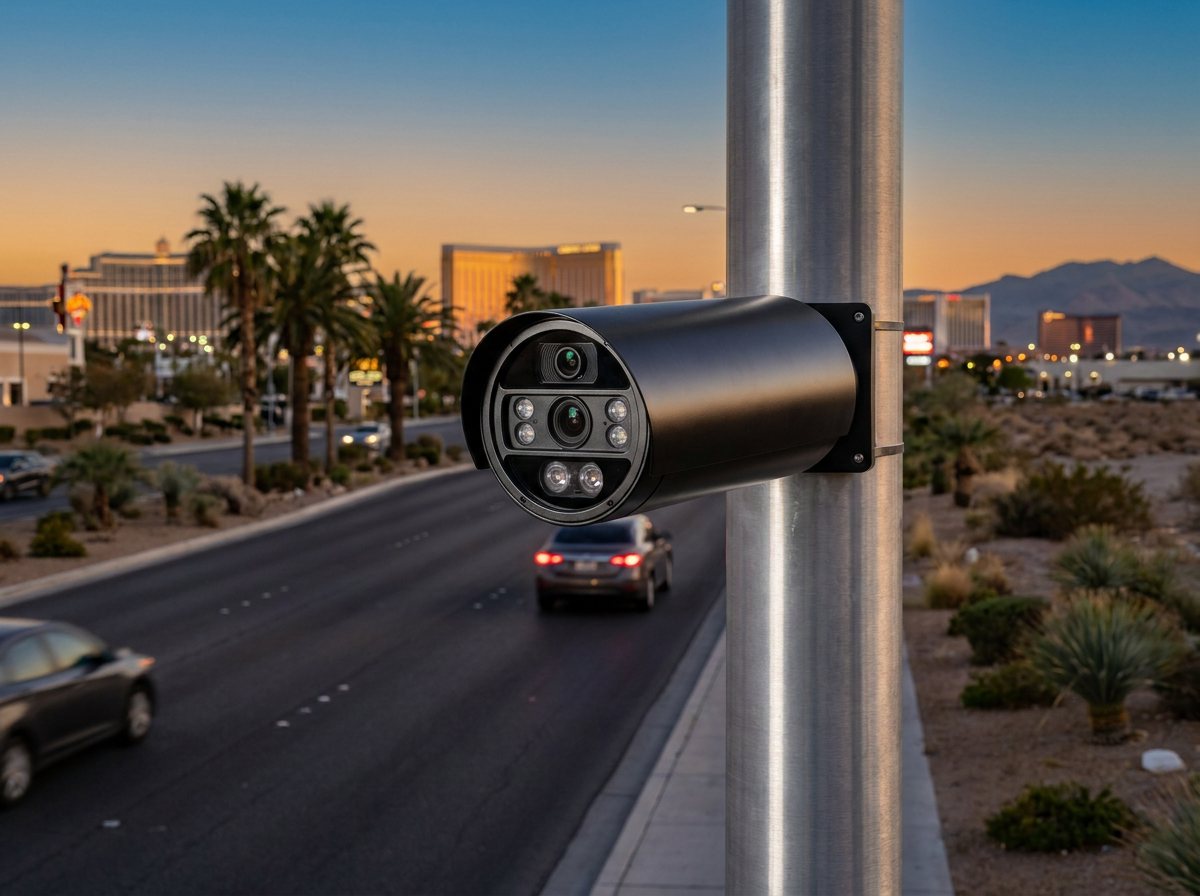
If you've driven through Las Vegas recently, there's a good chance you've passed one without knowing it. Flock Safety cameras are popping up all over the Las Vegas Valley — mounted on poles, traffic lights, and other structures — quietly reading and logging your license plate as you drive by.
So what exactly are they? Can police use them to ticket you for speeding or running a red light? And should you be concerned about your privacy?
Here's what you need to know.
What Is a Flock Safety Camera?
Flock Safety is a private company founded in 2017 that has become one of the largest sellers of Automated License Plate Reader (ALPR) technology in the United States. Their cameras do a lot more than just read plates — they use artificial intelligence to capture:
- The license plate number
- The vehicle's make, model, and color
- Physical identifiers like roof racks, dents, and bumper stickers
That information is instantly uploaded to Flock's cloud system, where it becomes searchable by participating law enforcement agencies across the country.
These are not traditional traffic cameras designed to catch speeders or red-light runners. Flock markets its cameras as crime-fighting tools: finding stolen vehicles, tracking criminal suspects, locating missing persons, and generating automatic "hotlist" alerts when a wanted plate drives past a camera. Homeowners associations and private businesses also operate Flock cameras, not just police.
Flock Cameras in Las Vegas
LVMPD has deployed 211 Flock Safety license plate reader cameras throughout the Las Vegas Valley. The program began in 2019, and the numbers are striking:
- In a single recent 30-day period, LVMPD reported more than 2.3 million vehicles detected
- More than 4,400 vehicles searched
- More than 14,000 "hotlist hits" — alerts triggered when a wanted plate passed a camera
One important thing to know: Nevada has no state law that specifically regulates how ALPR data can be used, stored, or shared. The Nevada Independent has reported on this gap. And because Flock's data is shared across thousands of agencies nationwide, information captured on a Las Vegas street can potentially be accessed by law enforcement in other states.
Can Flock Cameras Be Used to Issue Traffic Tickets in Nevada?
This is the question most drivers want answered, and the short answer is: under current Nevada law, using a Flock camera to automatically generate and mail a traffic ticket would almost certainly be prohibited.
Here's why.
Nevada Revised Statute 484A.600 — a law on the books since 1999 — prohibits governmental entities from using photographic, video, or digital equipment to gather evidence for the issuance of a traffic citation. This is the same law that bans red light cameras from mailing tickets to drivers. The statute was specifically aimed at automated enforcement: the idea of a machine issuing a citation without any officer involvement.
Because LVMPD is a governmental entity, NRS 484A.600 applies directly. A system that scans your plate and automatically generates a speeding or red-light ticket would appear to fall squarely within what the law prohibits.
There is a nuance worth understanding, though. The statute targets using camera equipment to "gather evidence to be used for the issuance" of a citation. That's different from every possible use of information a camera provides. If a human officer independently views Flock footage, initiates a lawful traffic stop, personally observes a violation, and then issues a citation based on what they observed — that's a different legal question than an automated system mailing you a ticket. Courts would need to weigh in on exactly where that line falls if officers began routinely issuing citations based primarily on Flock imagery.
For what it's worth, Nevada's 2025 Legislature considered but did not pass broad red light and speed camera bills. A narrower school bus stop-arm camera law (AB 527) did pass, creating NRS 484A.605 — but that law only applies to school districts and requires a law enforcement officer to review footage before any citation can be issued.
Mission Creep: What's Happening in Other States
Even if Nevada law currently provides some protection, recent events elsewhere are worth watching.
In December 2025, the Georgia State Patrol used a Flock camera to issue a traffic ticket to a motorcyclist. The citation noted: "CAPTURED ON FLOCK CAMERA 31 MM 1 HOLDING PHONE IN LEFT HAND." The incident was reported by 404 Media and highlighted by the Electronic Frontier Foundation (EFF) in March 2026 as a clear example of "mission creep."
Georgia State Patrol called it a "rare and unique circumstance." But the EFF pointed out that Flock cameras have now been used for:
- Traffic enforcement
- Immigration enforcement
- Monitoring First Amendment-protected activities
All of these were uses that many police departments had previously told the public would never happen.
Under Nevada's NRS 484A.600, the Georgia-style ticket — where camera footage itself is both the evidence and the basis for the citation — would appear to be prohibited here. But Nevadans should be aware that these uses are actively expanding in other jurisdictions, and no Nevada law currently specifically restricts how LPR data can be used beyond the citation-issuance ban.
The Bigger Privacy Picture
It's worth stepping back from the traffic ticket question to consider what Flock cameras actually represent.
These are not traffic cameras in the traditional sense. They are surveillance infrastructure — technology that collects data on every vehicle that passes by, whether or not the driver is suspected of anything at all.
The ACLU has described Flock as "building a dangerous nationwide mass-surveillance infrastructure." Civil liberties attorney Tre Lovell, commenting to Las Vegas news station KSNV, said that Flock cameras do not currently violate privacy rights because they track vehicles in public spaces — but he also acknowledged that cases of abuse have occurred in other jurisdictions.
The U.S. Supreme Court's Carpenter v. United States (2018) decision held that comprehensive location tracking can implicate Fourth Amendment protections. While no Nevada or federal court has directly ruled on Flock camera data specifically, that precedent is relevant background as legal challenges develop nationwide.
Flock announced in 2025 that it would add new safeguards, including:
- Reducing how long data is retained
- Flagging abnormal search behavior
- Giving departments more control over what is shared with outside agencies, including federal immigration authorities
Whether those promises prove meaningful in practice remains to be seen.
Want to Know If Your Vehicle Has Been Tracked?
Two resources are worth knowing about:
- haveibeenflocked.com — Enter your license plate to search a database of over 243 million known Flock searches and find out whether your vehicle has been flagged or tracked.
- deflock.org — An open-source project that maps license plate reader camera locations across the United States and provides resources for communities working to limit or challenge ALPR surveillance.
This article is for informational purposes only and does not constitute legal advice. Laws change, and individual circumstances vary. If you have questions about a specific legal situation, consult a licensed attorney.
If you've been injured in a traffic accident in Nevada, call the personal injury lawyers at Cap & Kudler for a free consultation with an attorney — (702) 878-8778.
Injured in an Accident? We Can Help.
Call Cap & Kudler for a free consultation. Our attorneys personally handle every case and fight to get you the compensation you deserve.
(702) 878-8778