
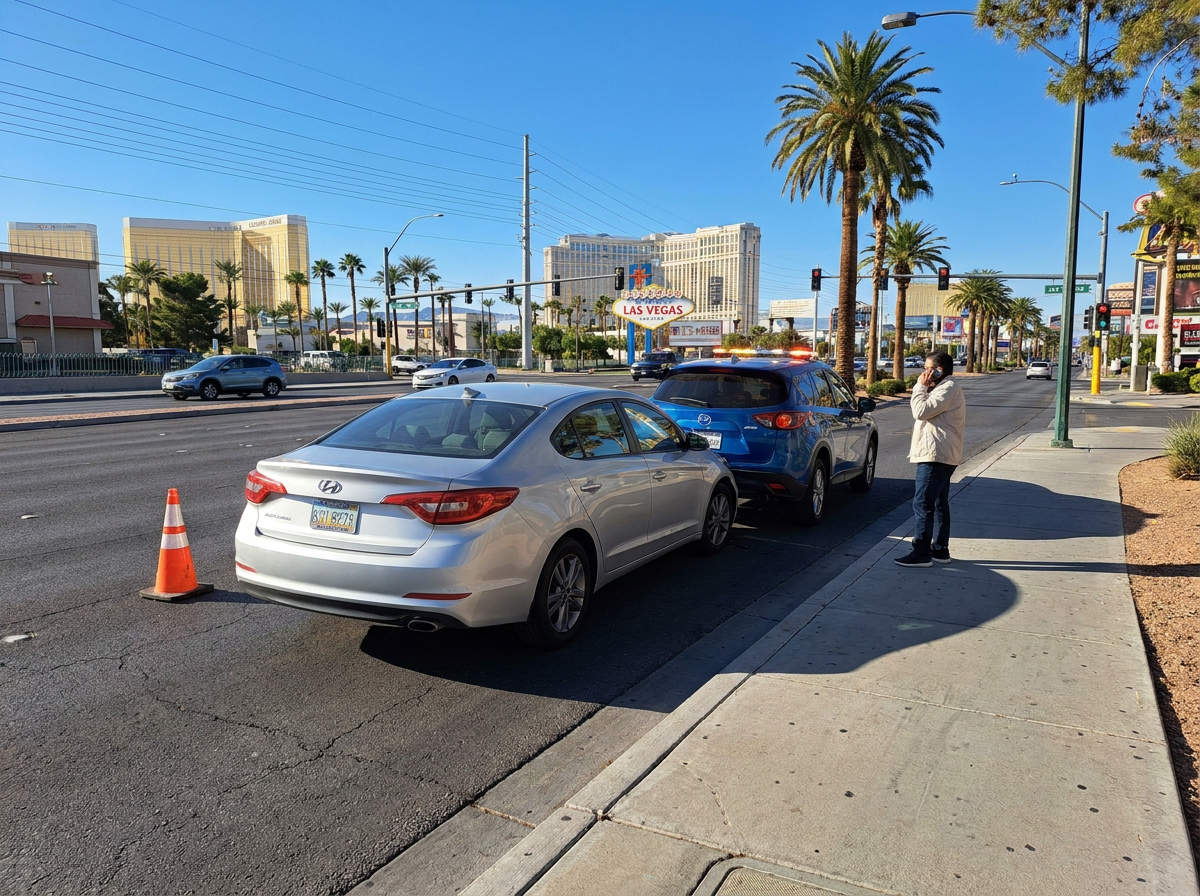
A car accident happens fast. One moment you're driving down the 215 or stopped at a light on Sahara, and the next your life is turned upside down. In those first confusing minutes, what you do — and what you don't do — can have a major impact on your health, your safety, and your ability to recover fair compensation.
This guide walks you through exactly what to do after a car accident in Las Vegas, step by step.
Step 1: Check for Injuries and Move to Safety
Before anything else, check yourself and any passengers for injuries. If anyone is hurt, don't move them unless there is an immediate danger — like a fire or oncoming traffic. Moving an injured person can worsen spinal or neck injuries.
If the vehicles are drivable and the accident is minor, move them to the shoulder or a nearby parking lot to clear the roadway. Turn on your hazard lights immediately. If you cannot move the vehicles, stay in your car with your seatbelt on until help arrives — standing in a live lane is dangerous.
Step 2: Call 911
Always call 911 after a car accident in Las Vegas, even if the collision seems minor. Nevada law requires you to report accidents involving injury, death, or property damage over $750. A police report creates an official record of what happened — and that record becomes critical evidence if you file a personal injury claim.
When officers arrive, give them an accurate, factual account of what happened. Don't speculate about fault or minimize your injuries. Symptoms like whiplash, concussions, and soft tissue damage often don't appear for hours or days after impact.
Step 3: Document the Scene
While you wait for police, use your phone to document everything you can:
- Photos of all vehicles involved, showing damage from multiple angles
- Photos of the overall scene — skid marks, road conditions, traffic signals, street signs
- Photos of any visible injuries
- The other driver's license plate, insurance card, driver's license, and contact information
- Names and contact information of any witnesses
- Badge numbers and names of responding officers
This documentation is far easier to gather at the scene than to reconstruct later. Insurance companies and defense attorneys will scrutinize every detail — having your own thorough record protects you.
Step 4: Exchange Information — But Watch What You Say
Exchange insurance and contact information with the other driver. Be polite and cooperative. However, avoid saying anything that could be construed as an admission of fault — including "I'm sorry," "I didn't see you," or "I think it was my fault." These statements can be used against you even if you didn't cause the accident.
Stick to the facts. Leave fault determinations to the police and, ultimately, the legal process.
Step 5: Seek Medical Attention Immediately
Get evaluated by a doctor as soon as possible — even if you feel fine. This is one of the most important steps, and one of the most commonly skipped.
Many serious injuries from car accidents don't produce immediate pain. Whiplash, traumatic brain injuries, internal bleeding, and spinal injuries can take hours or days to become symptomatic. A gap in medical care gives insurance adjusters ammunition to argue that you weren't really hurt — or that your injuries were caused by something else.
Go to an emergency room, urgent care, or your primary care physician the same day. Follow all treatment recommendations and keep every appointment. Your medical records are the foundation of your personal injury claim.
Step 6: Notify Your Insurance Company
Report the accident to your own insurance company promptly. Most policies require timely notice of accidents as a condition of coverage. Give them the basic facts — date, location, vehicles involved — but don't provide a recorded statement or accept any settlement offer until you've spoken with an attorney.
You are not required to give a recorded statement to the other driver's insurance company. Their adjuster is not on your side. Anything you say will be used to minimize what they pay you.
Step 7: Don't Post About the Accident on Social Media
This bears saying plainly: don't post photos, comments, or updates about your accident or injuries on any social media platform. Insurance defense teams routinely monitor claimants' social media and use posts — even innocent ones — to undermine injury claims. A photo of you at a birthday party the week after an accident can be used to argue you weren't really hurt.
Step 8: Contact a Las Vegas Car Accident Lawyer
Nevada's statute of limitations for personal injury claims is generally two years from the date of the accident. That sounds like a long time, but evidence disappears quickly — surveillance footage gets overwritten, witnesses become harder to locate, and the at-fault driver's insurance company is already building their defense.
An experienced Las Vegas car accident attorney can protect your rights from day one, handle all communication with insurance companies, and ensure you don't inadvertently harm your own case. The consultation is free, and you pay nothing unless you recover.
Common Mistakes to Avoid After a Las Vegas Car Accident
- Leaving the scene — Leaving without exchanging information is a crime in Nevada, even in minor accidents.
- Delaying medical care — Every day without treatment weakens your injury claim.
- Accepting a quick settlement — Early offers from insurance companies are almost always far below the true value of your claim. Once you accept, you can't go back.
- Talking to the other driver's insurer without an attorney — They are not required to look out for your interests. You are not required to speak with them at all.
- Assuming a "minor" accident means minor injuries — Low-speed impacts can cause serious injuries, especially to the neck, back, and head. Don't dismiss symptoms.
What Happens If the Other Driver Was Uninsured?
Nevada has one of the highest rates of uninsured drivers in the country — estimates put it between 10 and 15 percent. If the at-fault driver has no insurance, you may still have options through your own uninsured motorist (UM) coverage, underinsured motorist (UIM) coverage, or other avenues depending on the circumstances of your accident. An attorney can review your policy and identify every source of potential recovery.
The Bottom Line
The steps you take immediately after a car accident in Las Vegas directly shape your ability to recover — physically and financially. Stay calm, document everything, get medical care right away, and be careful about what you say to insurance companies before speaking with a lawyer.
If you've been injured in a car accident in Las Vegas or anywhere in Clark County, call the personal injury lawyers at Cap & Kudler for a free consultation with an attorney.
This article is for informational purposes only and does not constitute legal advice. Every case is different, and you should consult a qualified attorney regarding your specific situation.
Injured in an Accident? We Can Help.
Call Cap & Kudler for a free consultation. Our attorneys personally handle every case and fight to get you the compensation you deserve.
(702) 878-8778