
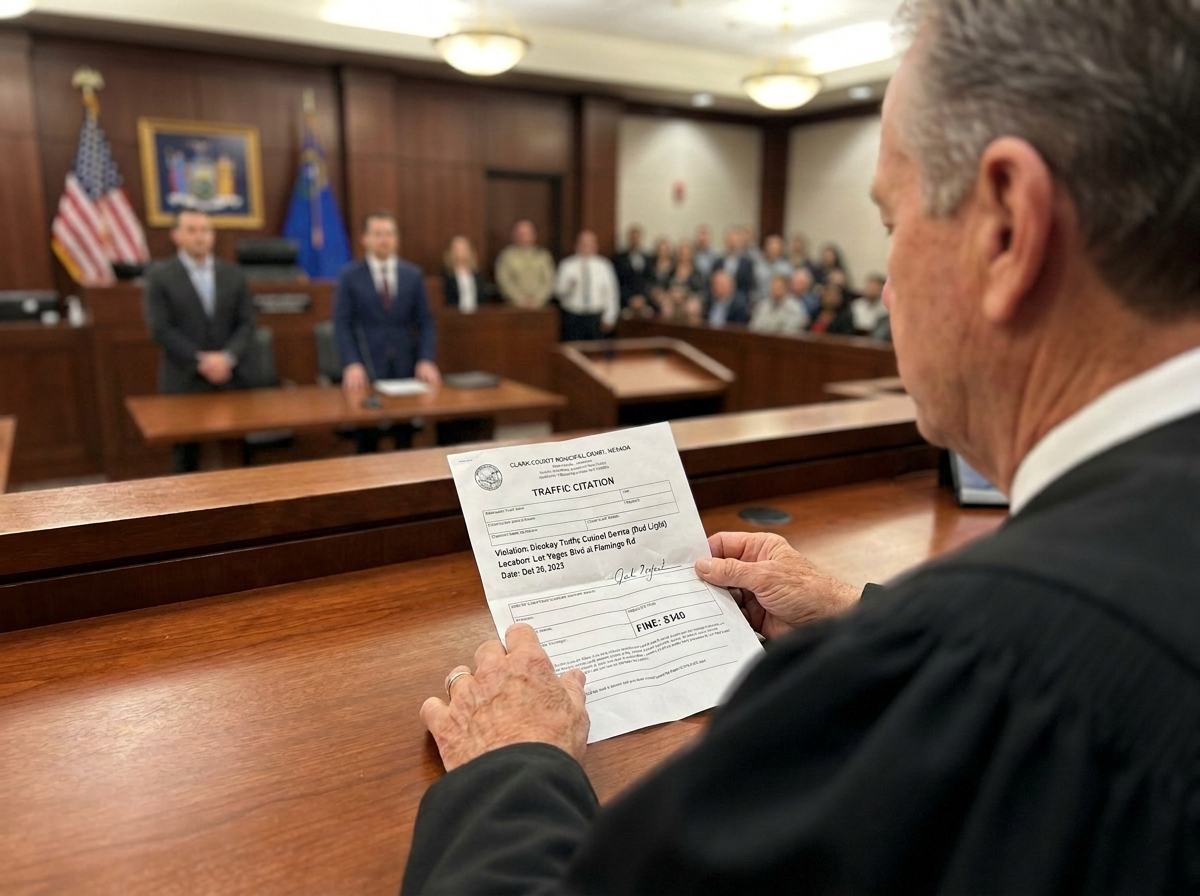
When personal injury clients come to us after an accident, they often bring with them a traffic citation or accident report — documents that can directly affect both their potential liability for causing the accident and their right to recover compensation from another driver. What many clients do not realize is that these documents are not necessarily accurate or reliable. A citation or accident report may contain inconsistent, incomplete, or outright incorrect information, and when it does, that document can be challenged — and potentially discounted as evidence against the client. A recent red light case illustrates exactly how those documentation flaws can unravel what initially looks like a straightforward official record.
It is worth noting at the outset that in Nevada, traffic tickets are civil infractions, not criminal charges. The State is the Plaintiff, and the driver is the defendant. The State bears the burden of proving its case, but the proceedings are civil in nature.
The Citation on Its Face
My client was cited for running a red light in violation of NRS 484B.307, which prohibits a driver from proceeding through an intersection against a red signal. On its face, the charge seemed straightforward. But when I reviewed the citation carefully, something stood out immediately.
At the top of the ticket, the officer wrote that my client was on Las Vegas Boulevard making a left turn onto Flamingo Road. At the bottom of the same ticket, the officer wrote that my client was headed west on Flamingo Road at Las Vegas Boulevard.
There is a fundamental problem with those two statements: Las Vegas Boulevard runs north and south. If my client was traveling westbound on Flamingo, he was not turning from Las Vegas Boulevard — he was already on Flamingo. These two descriptions cannot both be true. They describe two different scenarios at the same intersection.
The Officer's Statement Only Added Confusion
In an attempt to clarify, the officer submitted a supplemental written statement. Rather than resolving the inconsistency, it introduced a third version of events — describing my client as headed southbound on Las Vegas Boulevard and turning left to go eastbound on Flamingo. My client was prepared to testify that he was in fact headed northbound and turned left to go westbound.
So across the citation and the supplemental statement, there were at least three conflicting accounts of where my client was and which direction he was traveling. Each version placed him at a different approach to the intersection, potentially running a different signal entirely.
The Legal Standard: More Likely Than Not
In Nevada traffic cases, the burden of proof rests with the State. The standard is a preponderance of the evidence — meaning the court must find it more likely than not that the violation occurred as alleged. Due process also requires that a citation provide the defendant with fair and sufficient notice of the specific conduct alleged. A person cannot mount a defense against charges they cannot clearly identify.
When a citation is internally inconsistent to the point that the court cannot determine which act or which signal is at issue, it fails to meet that basic standard.
The Court Agreed — Before I Could Even Argue
I was prepared to walk through each inconsistency methodically. But before I could present a single argument, Judge David Brown noted the inconsistencies himself. He observed that the multiple, contradictory versions of the facts made it impossible to determine which red light — if any — had allegedly been run. Given that the court could not resolve which version of events was accurate, it could not find by a preponderance of the evidence that any specific violation occurred.
The case was dismissed.
What This Case Teaches Us
This outcome was not the result of luck. It was the result of careful review of every line of the citation before ever setting foot in the courtroom. Most drivers glance at a ticket, note the fine, and either pay it or show up unprepared. What they miss is that officers write citations quickly — often at the scene, under stress, with incomplete information. Errors happen. Contradictions slip through. And those contradictions have real legal consequences.
When Citation Errors Follow You Into a Personal Injury Case
The stakes get considerably higher when there is a collision involved.
Consider a left-turn scenario — one of the most common and most contested accident types in Nevada. Driver A is making a left turn through an intersection. Driver B is traveling straight in the opposite direction. They collide. Under Nevada law (NRS 484B.403), the driver making a left turn is generally required to yield to oncoming traffic proceeding straight. That baseline rule tends to point liability toward the turning driver.
But what happens when the officer's citation is riddled with the same kind of contradictions described above?
Three Versions of the Same Crash
If the citation places the turning driver in two different locations, or describes their direction of travel inconsistently — and then the officer's supplemental statement introduces a third version — neither driver has a reliable official record of what actually happened. In a personal injury claim, that ambiguity does not just affect whether a ticket gets dismissed. It directly shapes who is found liable, how much each driver may recover, and whether either driver recovers anything at all.
The turning driver and their attorney can argue that the citation's contradictions make it impossible to establish that the left turn was made unlawfully — that no one can say with certainty which signal was controlling, which lane the driver was in, or whether the turn was even completed when the impact occurred. The straight-through driver faces the same problem from the other side: if the record cannot reliably establish where the turning driver was or what they were doing, it becomes harder to prove the turning driver was negligent at all — or to rule out that the straight driver contributed to the crash.
Nevada's Comparative Negligence Rule
Nevada follows a modified comparative negligence standard. Under this rule, an injured person's recovery is reduced in proportion to their own fault — and if they are found to be more than 50% at fault, they recover nothing. That 50% threshold is often fiercely contested in left-turn collision cases to begin with. Add a citation full of contradictions, and both sides now have ammunition to shift that percentage in their favor.
An insurance company handling either driver's claim will look closely at every piece of documentation. If the police report conflicts with the citation, and the citation conflicts with the officer's own follow-up statement, the insurer's adjuster has cover to dispute liability, delay the claim, reduce the offer, or deny it outright. These are not hypothetical tactics — they are standard practice.
What a Personal Injury Attorney Looks For
An experienced personal injury attorney reviews all of this documentation with the same scrutiny applied to a traffic ticket defense. If the citation that was written at the scene contains internal contradictions — about direction of travel, about which lane the driver was in, about what signal they were under — that is not just an administrative error. It is evidence that the officer's account of the accident may be unreliable.
That unreliability can support your case if you are the injured driver. It can undercut the insurer's narrative that you were at fault. It can form the basis of an argument that liability has not been established to the degree the insurance company is claiming — and that a fair recovery demands a closer look.
The details on a citation may seem mundane. But in a left-turn collision where two drivers are pointing fingers at each other, those details can determine everything.
The information provided in this article is for general informational purposes only and does not constitute legal advice. No attorney-client relationship is formed by reading this content. Laws and procedures may vary and change; consult a licensed attorney for advice specific to your situation.
If you were injured in a left-turn collision or any other accident in Nevada, call the personal injury lawyers at Cap & Kudler for a free consultation with an attorney: (702) 878-8778.
Injured in an Accident? We Can Help.
Call Cap & Kudler for a free consultation. Our attorneys personally handle every case and fight to get you the compensation you deserve.
(702) 878-8778